
The Flight
On December 22, 2022, a Widerøe DHC-8 nearly impacted terrain due to a missed altimeter reset, highlighting critical procedural and EASA compliance gaps.
A De Havilland Canada DHC-8-103 (LN-WIP) operated by Widerøe departed Bodø (ENBO) for Svolvær (ENSH) in IMC. Marginal weather and runway snow clearance led to a 10-minute holding. During this time, the crew forgot to set the local QNH, leaving the aircraft flying 700 ft (213 m) lower than indicated.
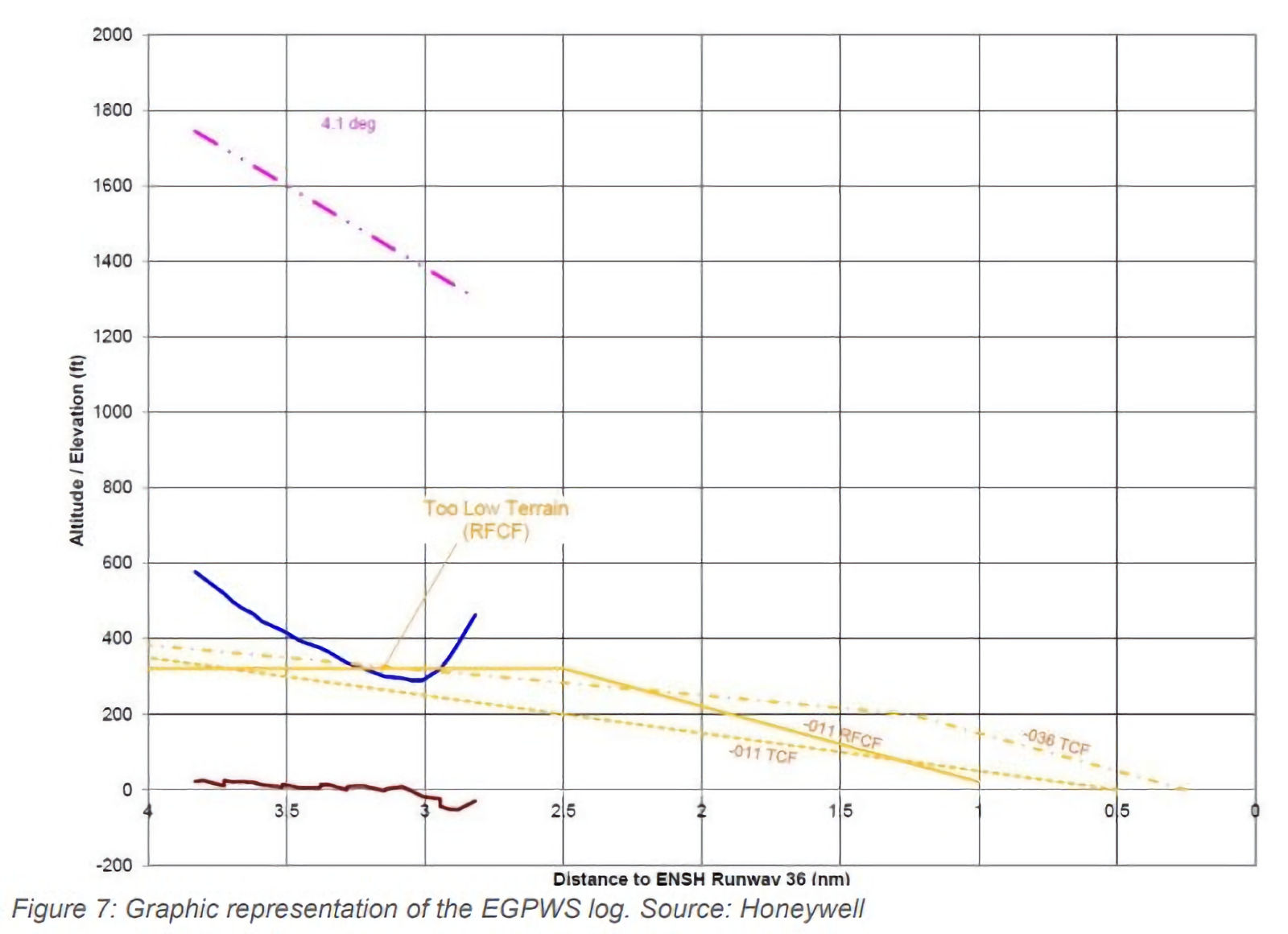
At 3.1 NM from Runway 01, the Enhanced Ground Proximity Warning System (EGPWS) triggered a “TOO LOW TERRAIN” warning, prompting an immediate go-around and diversion back to Bodø. The Norwegian Safety Investigation Authority (NSIA) classified it as a serious incident — a near-miss CFIT.
Summary of Flight WF834 Incident at Svolvaer Airport
On December 22, 2022, Wideroe flight WF834, operating a DHC-8-103 (LN-WIP) from Bodo (ENBO) to Svolvaer (ENSH), experienced a serious incident during approach due to an incorrect altimeter setting. The flight, carrying 29 passengers and three crew members, was commanded by a 43-year-old pilot with 153 hours as a commander, accompanied by a 35-year-old first officer. The crew faced challenging weather conditions, including variable winds, snow showers, and low visibility, prompting discussions on whether to use a GLS or LOC approach to runway 01.
The aircraft took off from Bodo, climbed to FL90, and proceeded to the OSRUL reporting point. Due to snow clearance at Svolvaer, the crew entered a holding pattern at FL90. They received multiple weather updates indicating deteriorating conditions, with visibility dropping to 1,000 meters and vertical visibility at 600 feet. The crew opted for a LOC approach to runway 01, but during descent, the barometric altimeter was incorrectly set to standard pressure (1,013 hPa) instead of the local QNH (987 hPa). This error caused the aircraft to fly approximately 700 feet lower than indicated, a discrepancy of about 27 feet per hPa.
At 1859 hrs, as the aircraft descended to a GPS altitude of 312 feet, the Enhanced Ground Proximity Warning System (EGPWS) issued a “Too Low Terrain” alert. The first officer promptly called for a go-around, and the crew executed a missed approach, climbing to 4,000 feet. The lowest altitude reached was 292 feet. Recognizing the severity of the incident and poor weather, the crew decided to return to Bodo, landing safely at 1924 hrs. No injuries or damage occurred.
The incident highlighted a critical error in altimeter setting procedures. The crew failed to reset the altimeter to the local QNH during descent, despite standard callouts and checklists. The EGPWS, equipped with older software (SW-011), triggered the warning, but a newer version (SW-036) would have alerted two seconds earlier. The aircraft’s Mode S transponder could not transmit barometric pressure settings, limiting air traffic control’s ability to detect the error. Wideroe’s investigation led to measures such as raising LLZ minima, upgrading cockpit systems, and enhancing training on altimeter settings and workload management. Avinor ANS implemented QNH display on radar screens and updated procedures to include QNH verification.
This incident underscores the risks of incorrect altimeter settings, as seen in similar events in Paris (2022) and Stavanger (2021). Recommendations from EASA and ICAO emphasize robust QNH verification, updated TAWS software, and crew training to mitigate such risks.
Analysis of Widerøe WF834 Incident
Incorrect barometric altimeter settings during non-precision approaches, as seen in the Widerøe flight WF834 incident at Svolvær Airport Helle on December 22, 2022, pose a severe risk of Controlled Flight Into Terrain (CFIT). The DHC-8-103 (LN-WIP) flew 700 ft below the indicated altitude due to an unset local QNH (987 hPa), triggering an EGPWS “Too Low Terrain” alert at 324 ft, prompting a missed approach and safe return to Bodø.
History of Flight
– Flight Details: Flight WF834 from Bodø (ENBO) to Svolvær (ENSH) was cleared to 4,000 ft but held at FL90 for ~10 minutes due to runway snow clearance.
– Approach Shift: The crew planned a GLS approach but switched to a more complex LOC approach late due to variable weather.
– Procedural Failures: High workload led to missed steps: no approach checklist, skipped pre-level check, and improper radio height verification. The commander initiated descent without full coordination with the first officer, who was managing radio communications.
– Outcome: EGPWS alert at 324 ft averted disaster; the crew executed a missed approach and returned to Bodø.
Operational Factors
Crew Resource Management (CRM)
– Poor communication and task allocation excluded the first officer from key decisions.
– High workload from simultaneous radio calls, weather updates, approach briefing, and cabin coordination overwhelmed the crew.
– The LOC approach’s complexity, compared to GLS, exacerbated time pressure, contributing to the missed QNH setting.
Procedural Compliance
– Missing the QNH setting triggered a cascade of procedural failures, as it initiates the approach checklist.
– A 17–20-minute gap between clearance and descent, combined with the Zeigarnik effect (perceiving QNH as “set” during holding), reduced recall.
– Pre-level and radio height checks were ineffective under high workload.
– NSIA recommends simplified, standardized QNH verification procedures.
Other Factors
– Short flights increase procedural demands, risking crew overload.
– Limited use of the standby altimeter; new procedures recommend setting it upon METAR receipt.
– Crew experience was adequate but may have influenced decision-making under pressure.
Technical Factors
Approach Minima
– Lower LOC minima versus GLS increased crew workload in marginal weather. Raising minima aligns approaches, easing pressure.
EGPWS
– The aircraft’s EGPWS (SW-011) alerted at 303 ft; newer SW-036 would have triggered 2 seconds earlier at 319 ft.
– Small QNH deviations may evade terrain alerts, exposing technical limitations.
Barometric Pressure Setting Advisory Tool (BAT)
– LN-WIP’s transponders lacked QNH transmission capability, preventing air traffic services from monitoring settings.
– NSIA recommends transponder upgrades for QNH transmission to enable monitoring.
Surveillance (AFIS)
– Avinor ANS’s surveillance (SUR) has limited coverage and no automatic QNH deviation detection procedures.
Risk Reduction
– Incorrect QNH is a recognized global risk (ICAO, EASA). NSIA recommends:
— Norwegian CAA conduct a risk assessment.
— Implement short- and long-term risk-reduction measures.
— Deploy technical barriers like QNH monitoring tools.
Our amazing team is always hard at work
Summary
The WF834 incident underscores how CRM breakdowns, procedural complexity, and technical gaps (e.g., non-QNH-transmitting transponders, outdated EGPWS) can create CFIT risks. Strengthening procedural barriers through standardized QNH checks, improving crew coordination, raising approach minima, and adopting technical solutions like transponder upgrades and QNH monitoring systems are critical to enhancing aviation safety and preventing recurrence.
Conclusion
The investigation revealed that Wideroe’s QNH-setting checklists and procedures, intended as independent safety barriers, were interdependent and thus less effective. No single technical system in Norwegian airspace can reliably detect QNH discrepancies, and human barriers alone proved insufficient. LN-WIP’s transponder could not transmit QNH data, preventing air traffic services (AFIS at Svolvaer) from monitoring the setting. While Avinor ANS’s NATCON system can display QNH for compatible transponders, Svolvaer’s AFIS lacks procedures to leverage this capability, as surveillance (SUR) is only a supporting tool.
The incident stemmed from a mix of technical limitations, human errors, and organizational factors. Wideroe has since enhanced CRM and workload management training, negating the need for NSIA’s recommendation on this front. However, NSIA issued three safety recommendations: (1) to the Norwegian CAA to evaluate and mitigate risks of incorrect QNH settings, (2) to Wideroe to upgrade transponders to transmit QNH data, and (3) to Wideroe to revise QNH verification checklists and procedures to bolster aviation safety.
Opinion
The highlights compliance gaps under EASA regulations (EU No 965/2012). The crew’s failure to reset the altimeter, per Widerøe’s Operations Manual, and the lack of QNH monitoring by Avinor ANS’s AFIS reveal systemic weaknesses. No injuries occurred, limiting immediate liability under Norwegian tort law or EU passenger rights (EC No 261/2004), but potential negligence claims loom if unaddressed. NSIA’s recommendations—CAA risk assessments, transponder upgrades, and checklist revisions—aim to bolster safety and compliance, aligning with EASA SIB 2023-03. Widerøe’s proactive training enhancements mitigate some risks, but swift implementation is critical to avoid regulatory sanctions and ensure aviation safety.
Secure Your Skies: Practical Expertise in Embedding Air Law into ICT Solutions
As leading consultants with specialized expertise in air law, aviation operations, and ICT, we empower airlines, air traffic services, and airports to achieve seamless compliance and operational excellence. Here’s how we can assist:
– Regulatory Audits & Gap Analysis: We conduct thorough reviews of your Operations Manuals (OM), Safety Management Systems (SMS), and procedures against EU Regulations (e.g., No 965/2012 on Air OPS) and NSIA recommendations, identifying vulnerabilities like QNH verification protocols to prevent incidents similar to WF834.
– Custom Training. Leverage our aviation insights to deliver tailored Aviation Training and for simulated scenarios that address high-workload environments, clear communications and procedural compliance.
– Risk Assessments & Implementation Plans: We guide you through mandatory risk evaluations, developing short- and long-term strategies to mitigate risks and align with global standards.
With nearly 20 years of combined experience in air law advisory, aviation safety consulting, and ICT innovation, we’ve helped clients avoid costly disruptions and enhance safety cultures.
Ready to safeguard your operations?
Contact us today for a complimentary compliance consultation at info@aviationmanagementsolutions.com or call +31 621 250449 (Frank Olberts) to schedule your session.
Source: https://nsia.no/Aviation/Aviation/Published-reports/2025-10
Photo Credit: Photo credit: Anna Zvereva / Flickr / License: CC by-sa.